
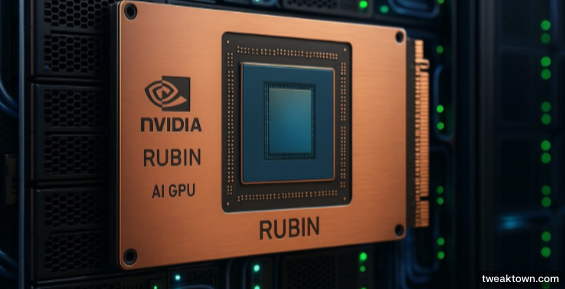
Key Insight
Nvidia’s Rubin architecture, featuring six newly taped-out chips built on TSMC’s advanced 3nm process, signals a complete technology overhaul and a strategic bet on TSMC’s manufacturing leadership, with trial production already underway as of August 2025. NVIDIA’s Rubin architecture represents a fundamental shift in AI computing that could cement the company’s dominance for the next decade. With analysts projecting potential $6 trillion market cap and the chips powering everything from data centers to sovereign AI initiatives, this development affects global technology infrastructure, geopolitical competition in semiconductors, and the broader AI revolution reshaping industries worldwide.
Background:
On August 22, 2025, Nvidia CEO Jensen Huang visited Taiwan Semiconductor Manufacturing Company (TSMC) to personally thank their teams and discuss Nvidia’s next-generation Rubin architecture. This groundbreaking architecture represents Nvidia’s first full chip redesign with all new components, including GPUs, CPUs, NVLink switches, and silicon photonics processors, all currently in TSMC’s fabs for trial production. Huang praised TSMC as one of the greatest companies in history and emphasized the critical partnership amid ongoing export and security challenges with China.
Top Three Reasons This Matters:
1. Rubin marks a foundational shift for Nvidia’s AI computing roadmap, leveraging TSMC’s cutting-edge 3nm N3P process and advanced HBM4 memory, enabling significantly larger and more powerful chips, and setting the stage for Nvidia’s expected 2026 product launch.
2. The close collaboration between Nvidia and TSMC exemplifies a pivotal semiconductor supply chain synergy, with Huang visiting Taiwan three times in 2025 alone, underscoring the critical role TSMC plays in Nvidia’s innovation and capacity to scale AI chip production.
3. Amid geopolitical tensions and export restrictions affecting Nvidia’s China AI chip sales, the Rubin launch timeline and production success at TSMC will be essential for Nvidia’s global competitiveness, especially as Nvidia navigates uncertain regulatory landscapes and seeks alternative new designs like the Blackwell-based B30A chip.
Credit perplexity
https://www.perplexity.ai/page/nvidia-s-jensen-huang-confirms-3YSQtH5bR2GrVLSA5TuKdA