
Humanoid robotics could unlock one of the largest economic opportunities in history.
In a recent report, William Blair estimated that the U.S. physical labor market alone represents a $3.8 trillion to $5.4 trillion annual opportunity if humanoid robots become commercially viable. The global opportunity could ultimately be measured in the tens of trillions of dollars annually.
The opportunity is enormous, but so are the societal implications. Humanoid robotics has the potential to reshape employment, productivity, and the relationship between humans and intelligent machines. Whether one views that future with optimism, concern, or a mix of both, the strategic implications are too significant to ignore.
That led me to ask a bigger question:
What’s the best way to understand a technology industry?
I’ve found it helpful to begin with two questions:
1. What fundamental capability does the industry create?
2. What is the defining challenge that determines its long-term success?
Applying those questions to humanoid robotics changed how I think about the industry.
What fundamental capability does the industry create?
General-purpose labor.
That vision is driving intense investment from companies such as Tesla, Figure AI, Apptronik, Agility Robotics, Boston Dynamics, Unitree, and UBTech, all seeking to commercialize general-purpose humanoid robots.
The economic opportunity is enormous, but so are the societal implications. Humanoid robotics has the potential to reshape work, productivity, and the relationship between humans and intelligent machines. Whether one views that future with optimism, concern, or a mix of both, the strategic implications are too significant to ignore.
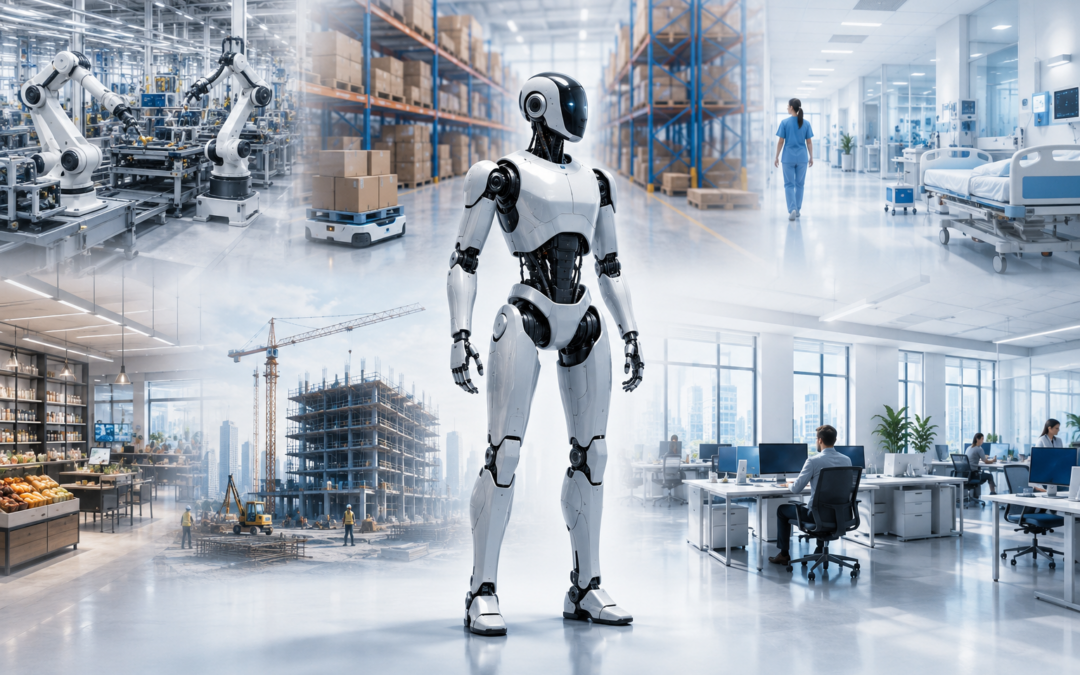
Unlike industrial robots designed for specialized tasks, humanoids are intended to work across the wide variety of environments already built for people, from factories and warehouses to hospitals, construction sites, retail stores, offices, and eventually homes.
What is the defining challenge that determines its long-term success?
Humanoid robots must combine human-like versatility with machine-like economics.
Success requires integrating advances in artificial intelligence, perception, manipulation, mobility, batteries, manufacturing, reliability, and cost into a single commercially viable system.
This perspective also changes how I think about industry leadership.
The long-term winners will be the companies that successfully integrate AI, robotics, manufacturing, supply chains, and deployment into scalable production systems.
Humanoid robotics is becoming an economic story as much as a technology story. The companies that solve the economics of general-purpose labor will shape one of the defining industries of the twenty-first century.