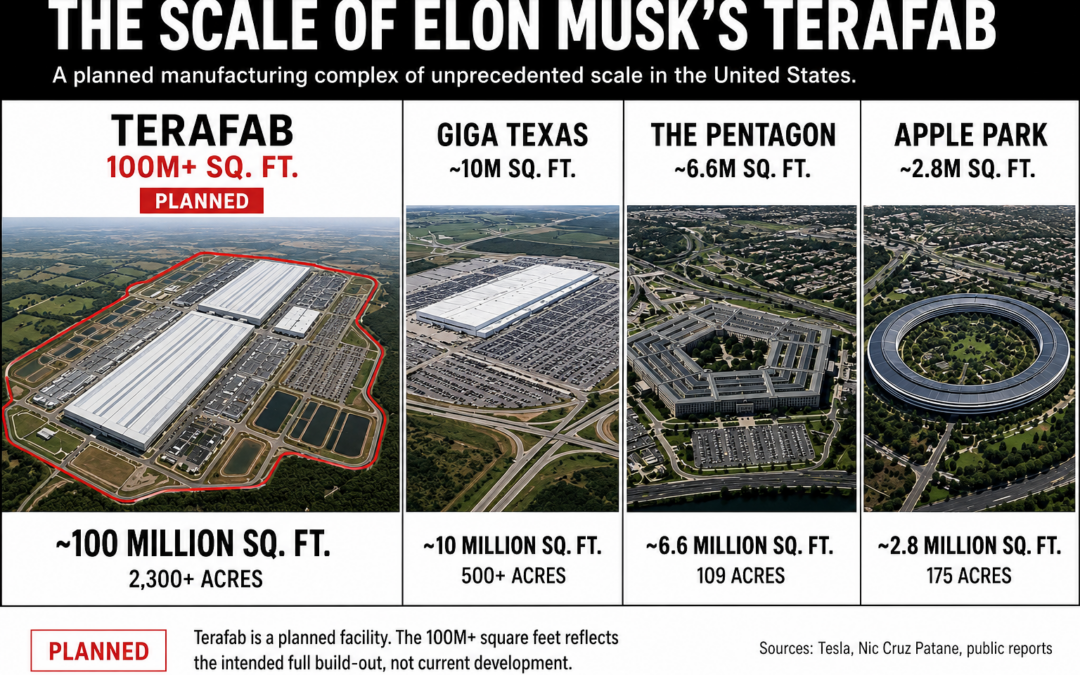
When Elon Musk first described Terafab, the scale was difficult to comprehend.
A semiconductor manufacturing complex potentially exceeding 100 million square feet, eventually representing as much as $119 billion in investment.
With Elon Musk, however, even the most ambitious ideas have to be taken seriously.
And now Terafab is beginning to move from vision toward a concrete industrial plan.
SpaceX has selected Grimes County, Texas, for the first large-scale Terafab facility, with an initial investment of $16.8 billion, while Tesla is developing a smaller semiconductor research facility at Giga Texas.
Perhaps even more significant is Intel’s involvement. Intel brings decades of expertise in advanced semiconductor manufacturing, and Tesla plans to use Intel’s upcoming 14A manufacturing process.
Intel’s involvement could be strategically important to both sides. Musk gains access to semiconductor manufacturing expertise that would take decades to recreate, while Intel could gain the kind of large, demanding external customer its foundry business has been seeking.
Why not simply rely on TSMC? Musk appears to have concluded that his long-term ambitions require semiconductor manufacturing capacity under his own control. Rather than depend entirely on outside foundries, Terafab would give his companies dedicated capacity while using partners such as Intel for critical process technology and manufacturing expertise.
The long-term vision is extraordinary: an integrated manufacturing complex bringing together advanced logic, memory, packaging, and testing to produce chips for AI, autonomous vehicles, Optimus robots, and potentially space-based computing.
The implications could extend far beyond Musk’s companies. A buildout on this scale could generate enormous demand for semiconductor equipment from companies such as ASML, Applied Materials, Lam Research, KLA, and others, while helping establish a much larger U.S.-based advanced semiconductor manufacturing ecosystem. If Intel’s 14A technology succeeds at Terafab, it could also strengthen Intel’s position as a credible U.S. alternative to TSMC for leading-edge manufacturing.
There is still an enormous difference between announcing a $119 billion vision and actually building it. Advanced semiconductor manufacturing is among the most difficult things humans do.
But Terafab is no longer just an interesting idea.
It is beginning to look like something Elon Musk actually intends to build.
#Semiconductors #AI #Intel #Tesla #SpaceX #Technology