
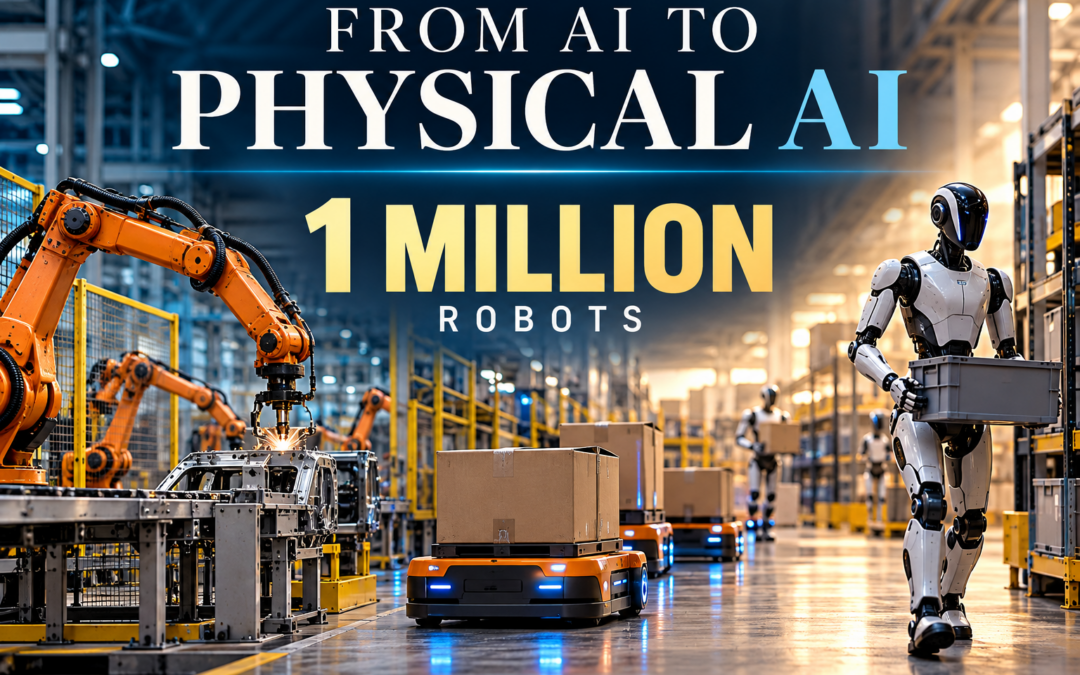
Amazon has now manufactured more than 1 million robots in the United States. Those robots help handle 75% of the customer orders Amazon delivers worldwide, and the company isn't slowing down. It just announced a new $100+ million manufacturing facility in Indiana to build even more robotic systems.
THE BIG PICTURE
Amazon isn't alone. Toyota estimates that modernizing its factories and supply chain could eventually require approximately 400,000 robots, with potential spending of $6.4 billion annually beginning in 2028.
Industrial robots have been working in factories for decades, performing highly repetitive, carefully programmed tasks. What's changing is the intelligence behind them. Advances in AI are increasingly giving machines the ability to perceive their environment, learn tasks, make decisions, and adapt to changing conditions.
FROM AI TO PHYSICAL AI
For the past few years, we've watched AI transform what happens on our computer screens—how we write, search, analyze information, create images, and develop software. Robotics brings that intelligence into the physical world, where machines can increasingly do more than process information: they can act on it.
Amazon's million robots and Toyota's plans suggest something much larger than another round of factory automation. We are entering the age of mass-produced intelligent machines.
JeffreyLCooper.com
Technology Analyst & Author
My novel: When Machines Begin to Dream
“Profound and moving.” The U.S. Review of Books | “Gripping.” Midwest Book Review | “Crisp and cinematic.” The BookLife Prize
#Robotics #ArtificialIntelligence #Manufacturing #Automation