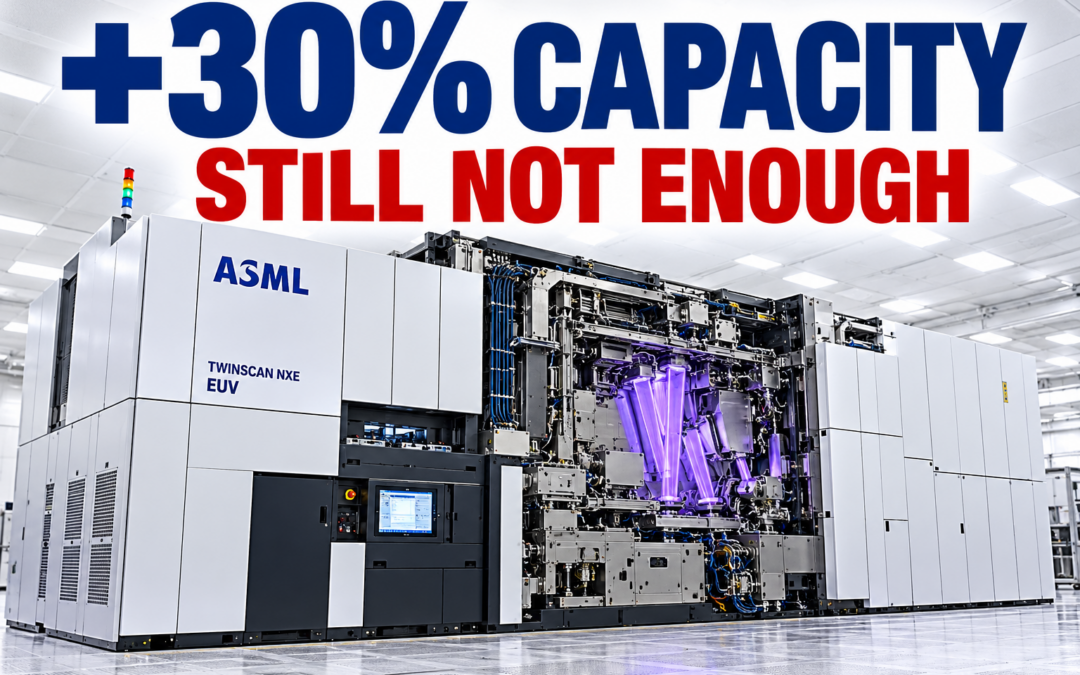
The AI infrastructure boom is creating extraordinary demand for semiconductor manufacturing equipment. On October 14, ASML announced plans to increase production capacity for its Low-NA EUV lithography and DUV immersion systems by approximately 30% in 2027, with another 30% increase under consideration for 2028.
Two consecutive increases of 30% would represent a cumulative expansion of approximately 69% in just two years. Yet ASML expects demand to exceed its planned production capacity in both 2027 and 2028. ASML reports that some customers are already discussing equipment requirements extending into 2029 and 2030, suggesting that strong demand could continue well beyond its current capacity expansion plans.
THE CHALLENGE OF SCALING THE WORLD'S MOST ADVANCED MACHINES
Having spent 14 years at ASML, I appreciate the extraordinary complexity of manufacturing lithography systems. An EUV lithography machine involves approximately 100,000 parts supported by a global supply chain of more than 5,000 suppliers. Expanding production while maintaining exceptional precision and reliability is an enormous challenge.
The implications extend well beyond ASML. TSMC, Samsung, Intel, and other semiconductor manufacturers depend on advanced lithography equipment to expand chip production. When equipment demand exceeds available capacity, the consequences ripple throughout the semiconductor industry.
The AI boom is no longer just a race to develop more powerful chips. It is a race to manufacture the machines needed to produce them.
JeffreyLCooper.com
Technology Analyst & Author
My novel: When Machines Begin to Dream
amazon.com/dp/B0H85WBVC8
“Profound and moving.” The U.S. Review of Books | “Gripping.” Midwest Book Review | “Crisp and cinematic.” The BookLife Prize
#ASML #Semiconductors #AIInfrastructure #EUV #TSMC